A Tale of Two Islands
Alan Gray – 14th March 2012
Introduction
This talk was the 6th in the 2011/2012 season and was given by Alan Gray. The talk drew on his recent trip to the Lesser Antilles in particular Grenada and Barbados. The Islands are full of fascinating flora, fauna and anthropology, not to mention swimming, diving and rum. However Alan was able to resist all these temptations to explore and record the contrasting geology of the two islands which formed the basis of his talk to us.
Plate Tectonics
As the islands are in the region of an active Caribbean subduction zone the first part of the talk explained the basics of Plate Tectonics (PT). This was necessary to better understand the later descriptions and explanations of the geology of Grenada and Barbados. The basic ideas underlying PT were described in which oceanic crust is created from the upwelling molten but viscous mantle magma at great depth along mid-ocean ridges. This then slowly spreads out and is subducted under the next continental crust and absorbed back into the mantle. The continents move with this process on the current 13 Plates.
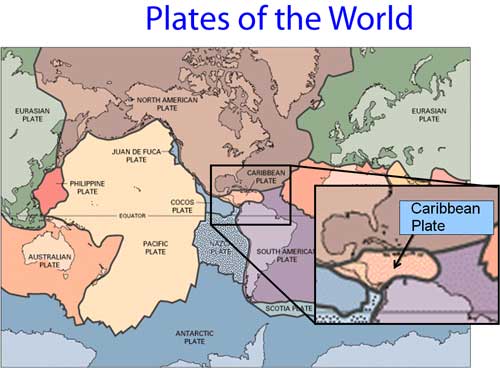
The Caribbean Plate (CP) and associated tectonics is very complicated and there is still much debate and disagreement over it. It would appear that the eastern edge of the CP is a classic subduction zone but the remainder is a set of ‘micro plates’ all moving at different rates and directions. There is still debate about the origin of the CP and whether it has moved as an entity from the Pacific area or whether it has formed in situ. Overall the CP itself moves in the same direction as the Atlantic Plate (AP) but at a slower rate (11 mm/year) compared to the AP (24 -27 mm/year). This accounts for the subduction zone on the eastern edge and the overall movement of the CP from west to east .
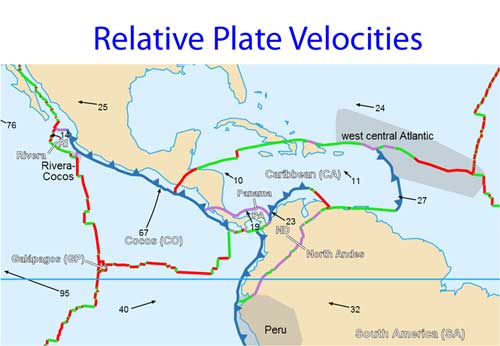
The lesser and greater Antilles actually lie along two parallel island arcs formed at different times in the subduction zone. The outer of these (Barbados) is older limestone and the inner (Grenada) is actively volcanic (i.e. eruptions in recorded history). This is the reason for the big differences in the Geology of Grenada and Barbados.
Grenada
While Grenada and Barbados have similar heavy tropical rainfall only Grenada is covered in streams because of its impermeable volcanic rocks.
There is much evidence of volcanic activity on Grenada. Stratovolcanoes are present which have been active during the last few thousand years.
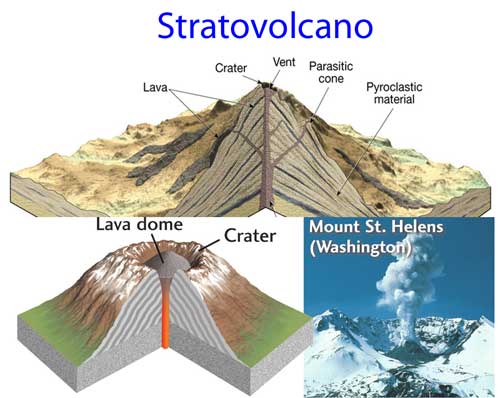
These types of volcanoes (e.g. Mount St. Helens in Washington State) erupt explosively due to dissolved gases in the rising magma de-gassing explosively on eruption through the covering, more dense and higher melting point crystalline material. The resulting vertical jet and subsequent pyroclastic flows cover the flanks of the volcanoes. There have been no such events in recorded history on Grenada. However such an eruption occurred in Martinique when Mount St. Pierre erupted in 1902 killing 30,000 people.
These pyroclastic flows form a complex deposit called ignimbrite which characterise most rocks in Grenada. This gives rise to quite fertile topsoil. Some beaches on Grenada are black also due to this volcanic deposit.
The most recent volcanic eruption in Grenada was about 1000 years ago at St. George. This formed a large cinder cone which is mined today for domestic use There are still active volcanoes near Grenada but they are under the sea to the North. The most well known is called ‘Kick-em-Jenny’ and more recently discovered is ‘Kick-em-Jack’ in the same area.

Barbados
Although Barbados is only 150 miles from Grenada it has a quite different geology and is not strictly on the current CP. It was formed much earlier (50 – 20 MYA) from subduction of the AP under the then CP.
This earlier plate collision initially, and unusually, caused both plates to buckle and rise up. This pushed the overlying seafloor sediment up resulting in the Barbados ridge.

Corals then grew (800 – 500 KYA) in the resulting shallow sea thus building coral reefs on the seafloor sediment (Sandstone and Limestone). Hence much of Barbados is made of coral overlying the sedimentary limestone and sandstone.
The coral has slowly dissolved in acidic rain causing high porosity. This allows rain to seep into the rocks rather than creating rivers and streams in contrast to Grenada.
Because of the underlying sedimentary rock structure, oil deposits have also formed under Barbados which are not found on ‘volcanic’ Grenada. Interestingly this has had a beneficial effect on understanding the geology of Barbados as many boreholes have been drilled in the search for oil!
Oil also naturally comes to the surface in ‘oil seeps’ where it is thick and viscous.
The eastern coast of Barbados is pounded by Atlantic storms and has become greatly eroded. There is evidence past coastal erosion which is now well inland (presumably when sea levels were higher).
In some areas of inland Barbados there are many examples of Oceanic deposits. In the Scotland District there is Oceanic ‘Allochthon’ which is a class of compressed sedimentary material known as ‘Siliciclastic Sediments’. Some of these formations have complicated and dramatic folding. It is now believed that the original material that formed these oceanic sediments came from the Orinoco delta in Venezuela. These sediments were washed out into the Caribbean sea south of the Lesser Antilles. This conclusion is based on detailed comparison of the chemistry of the delta sediments and those found on Barbados.
In addition to its interesting geology, oil and rum, Barbados was also the site for the world’s largest gun! In 1961 the High Altitude Research Program (HARP) was started as a joint collaboration between the US Department of Defence and the Canadian Department of National Defence. The program was designed as a low cost method of researching the re-entry problems of ICBMs by firing models from a giant gun. It may also have been ultimately aimed at a (fatally flawed!) method of launching objects into low earth orbit. HARP did however achieve the world record for the highest altitude achieved by a gun of 112 miles which still stands today. The project was abandoned shortly after in 1966 but the rusty remains of the various guns can still be seen.

Dick Harris